India | World | Business | Tech | Sports | Politics | Economy | Entertainment
UGC Equity Regulations 2026: Supreme Court Stays the Rules — What You Need to Know
On January 13, 2026, UGC notified landmark equity regulations for higher education institutions. But the Supreme Court of India stayed these rules on January 29. Discover what the UGC Equity Regulations 2026 contain, why the Supreme Court intervened, and what happens next.
The DyGrow
2/19/20264 min read

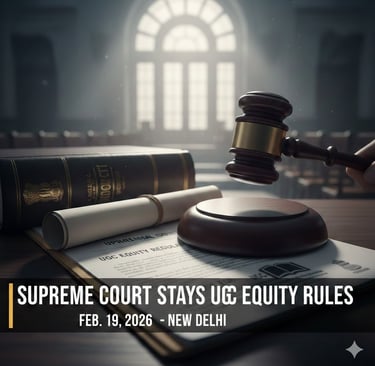
UGC Equity Regulations 2026 in India: Overview and Impact
India's higher education sector is at the center of a major legal and policy storm in 2026. The University Grants Commission (UGC) introduced the 'Promotion of Equity in Higher Education Institutions Regulations 2026' on January 13, 2026. These regulations aimed to make higher education more inclusive for marginalized communities. However, the Supreme Court of India placed a stay on these regulations on January 29, 2026, following legal challenges from multiple institutions and petitioners.
What Are the UGC Equity Regulations 2026?
The UGC Equity Regulations 2026, officially titled 'Promotion of Equity in Higher Education Institutions Regulations 2026', were notified on January 13, 2026, under the University Grants Commission Act, 1956. These regulations directed all centrally-funded higher education institutions — including IITs, IIMs, NITs, and central universities — to create institutional Equity Cells, prepare Annual Equity Action Plans, and provide special provisions for students from Socially and Educationally Backward Classes (SEBCs), Economically Weaker Sections (EWS), women, transgender persons, differently-abled individuals, and people from remote and tribal areas. The UGC stated the goal of these regulations was to eliminate barriers to access, ensure diverse representation, and create a level playing field in higher education.
Key Provisions of the Regulations
The UGC Equity Regulations 2026 included the following major provisions:
1. Equity Cells: Each institution must establish a dedicated Equity Cell responsible for implementing, monitoring, and reporting equity-related measures.
2. Annual Equity Action Plan: Institutions must prepare and submit an Annual Equity Action Plan to the UGC, outlining specific steps taken to improve equity.
3. Chief Equity Officer: Appointment of a senior faculty member or administrator as Chief Equity Officer to oversee all equity-related activities.
4. Financial Support: Special scholarships, fee waivers, stipends, and accommodation facilities for students from marginalized communities.
5. Representation: Ensuring adequate representation of equity groups in admission committees, academic councils, and grievance redressal mechanisms.
6. Help Desks and Counselling: Setting up dedicated support services for first-generation learners and those from underprivileged backgrounds.
7. Anti-Discrimination Policy: Mandatory adoption of strict anti-discrimination policies with penalties for violations.
8. Incentives for Compliance: Institutions demonstrating measurable improvement in equity outcomes to receive incentives in funding and rankings.
The Supreme Court Stay: What Happened?
Just 16 days after the UGC notified the Equity Regulations 2026, the Supreme Court of India intervened. On January 29, 2026, a bench of the Supreme Court placed a stay on the operation of these regulations after hearing petitions filed by several premier institutions, faculty associations, and individual petitioners challenging the constitutional validity of the regulations.
The petitioners argued that the UGC had overstepped its authority by mandating institutional policies that fell within the purview of individual universities and their governing bodies. They contended that the regulations:
- Violated the autonomy of educational institutions guaranteed under Article 19(1)(g) and Article 30 of the Constitution.
- Imposed administrative and financial burdens without adequate budgetary support from the Centre.
- Were ultra vires the UGC Act, 1956, which does not grant UGC the power to direct internal institutional governance policies.
- Could undermine merit-based selection and admission processes at elite institutions such as IITs and IIMs.
The Supreme Court issued notice to the UGC and the Ministry of Education to file responses and listed the matter for further hearing.
Arguments in Favour of the Regulations
Proponents of the UGC Equity Regulations 2026 argue that such measures are long overdue and essential for transformative change in India's higher education system. Their arguments include:
- India's premier institutions like IITs and IIMs continue to have very low representation of students from SC, ST, OBC, and EWS categories in postgraduate and doctoral programs.
- First-generation learners from rural and tribal backgrounds face significant structural disadvantages that cannot be addressed through admissions alone.
- The regulations align with India's constitutional mandate under Articles 15(4), 15(5), and 46 to promote educational interests of weaker sections.
- International rankings and UNESCO recommendations call for equity frameworks in higher education institutions.
- Data from AISHE surveys consistently shows that students from marginalized groups drop out at higher rates due to financial and social challenges that these regulations aim to address.
What Happens Next?
With the Supreme Court stay in place, all provisions of the UGC Equity Regulations 2026 are currently suspended. Here is what to expect in the coming weeks and months:
1. UGC Response: The University Grants Commission is expected to file a detailed counter-affidavit defending the regulations before the Supreme Court.
2. Ministry of Education Position: The Ministry of Education must clarify whether the Government supports the regulations as notified or intends to revise them.
3. Expert Committee Review: There may be calls for an independent expert committee to review the scope and implementation framework of the regulations.
4. Revised Draft: The UGC may choose to withdraw the current regulations and introduce a revised, more consultative version that addresses concerns about institutional autonomy.
5. Public Debate: The controversy is expected to spark wider debate among academics, policymakers, student organizations, and civil society about the best path toward achieving equity in Indian higher education.
The outcome of this case will have far-reaching implications for higher education policy in India and the future of equity-based governance frameworks in the country's premier institutions.
Conclusion: A Test of Constitutional Balance
The UGC Equity Regulations 2026 represent a bold attempt to institutionalize equity in India's higher education system. However, the Supreme Court's stay signals that fundamental questions about the scope of UGC's regulatory power, institutional autonomy, and the constitutional framework of affirmative action in education need to be addressed before any implementation can proceed.
This case ultimately poses a crucial question: How do we balance the constitutional mandate of equity with the operational autonomy of India's premier academic institutions? The answer to this question will define the future of inclusive education in India for years to come.
Stay tuned to The DyGrow for the latest updates on this and other major policy developments.